
At Hyacinth, we’re always eager to test the latest advancements in large language models (LLMs). More and more these days, we hear the AI vendors touting huge context windows in which you can put in massive amounts of documents, data, or other information. We could feed entire project histories, product documentation or data sets – whatever was relevant to the project and the AI will process it all to perfectly deliver the requested insights. We dove right into it, ready to be more productive and save many work hours.
A couple of weeks later, however, our excitement vanished. The AI that had initially impressed everyone was now making glaring mistakes on tasks it should have handled easily. Monthly AI bills had tripled, and instead of the productivity boost we’d hope for, we were spending hours each day cleaning up errors and re-running failed processes.
It became clear that simply throwing more data into a bigger context window wasn’t the magic solution we’d hoped for. In fact, they sometimes seemed to be making things worse. What we were experiencing has a name—”context rot.” While the AI industry has been racing to build bigger context windows, promising they can handle entire documents or complex tasks all at once, the reality is far more complex.
This disconnect has sparked a fundamental shift from prompt engineering to context engineering. Rather than simply crafting better prompts or stuffing more data into them, context engineering focuses on strategically organizing and presenting information to AI systems. It’s the difference between throwing everything at the wall to see what sticks versus carefully curating what your AI needs to succeed.
Here’s the uncomfortable truth: Your expensive AI upgrade might be making your business operations less reliable, not more. But there’s a path forward that smart organizations are already taking.
What We Learned from New Research
Recent research by Chroma has revealed a startling discovery about how AI models handle large amounts of context. Scientists found that AI performance doesn’t improve linearly with more information—instead, it often degrades significantly.
The research showed that when AI models receive extensive context, they begin to lose track of important details buried within the information. It’s the same as asking someone to find a specific piece of information while they’re standing in a library with thousands of open books scattered around them. More books don’t make the task easier; they create overwhelming noise that makes finding the right answer harder.
Tasks that should be straightforward—like extracting a specific date from a document or identifying key stakeholders in a business process—become unreliable when that information sits within a massive prompt filled with tangential details.
The below chart from Chroma’s study shows the Claude family’s performance on focused prompts compared to full prompts.
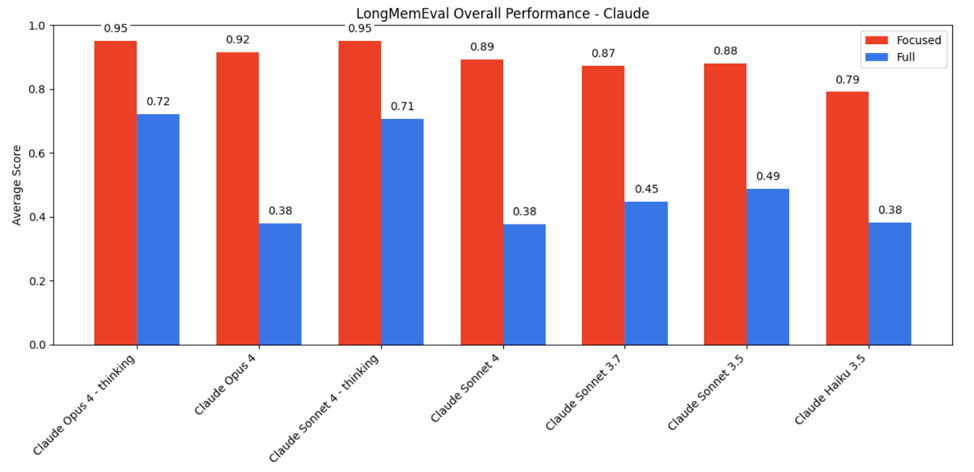
This discovery is reshaping how forward-thinking organizations approach AI implementation. Instead of the “bigger is better” mentality that dominated early AI adoption, companies are recognizing that context engineering strategies deliver superior results. The goal isn’t to maximize the amount of information you can cram into a single prompt, but to optimize how information is structured and presented.
Consider a financial services firm trying to process loan applications. Rather than feeding the AI every piece of documentation at once, context engineering might involve presenting information in logical sequences—first applicant demographics, then financial history, then risk factors. This structured approach helps the AI maintain focus and accuracy throughout the analysis.
Additional research, including the academic “Lost in the Middle” study, demonstrates consistent performance patterns across models where LLMs perform best when relevant information appears at the beginning or end of prompts, with substantial performance drops for mid-context information.
Five Real Business Problems with Big Prompts
1. Accuracy Goes Down When Context Goes Up
One of the most important concerns for business leaders is accuracy. For example, when multiple distractors (which are semantically similar items that an LLM might think is the answer it is looking for) are present, accuracy drops 40-60%. This isn’t theoretical—it translates directly to real-world failures.
Financial institutions implementing AI for Know Your Customer (KYC) processes are experiencing this firsthand. When these systems receive comprehensive customer files—complete transaction histories, multiple identity documents, and extensive background checks—they’re generating false positives at alarming rates. Or, an AI accurately flags compliance issues in 500-word summary but missing the same issues when processing full 100-page regulatory filings..
Clinical trial organizations face similar challenges. Research teams feeding AI systems complete patient datasets are discovering that adverse event detection becomes less reliable as the dataset gets larger, not more. The AI might miss critical drug interactions because it’s overwhelmed by routine medical history that clouds pattern recognition.
2. Costs Skyrocket Without Better Results
The math is brutal. Most AI services charge based on the number of tokens processed, meaning larger prompts create exponentially higher costs. A company processing 1,000 documents monthly might see their AI bill jump from $500 to $5,000 simply by including more context—without any improvement in output quality. Or worse, a reduction in quality and accuracy.
When you’re paying more for worse performance, the ROI calculation gets ruined. Organizations that budgeted for AI as a cost-saving measure find themselves with budget overruns and reliability problems that require additional human oversight, creating a double cost burden. This is one reason we hear that so many AI projects are not hitting their ROI goals.
3. The Hidden Cost: Training Employees to Be Prompt Engineers
Companies often underestimate the human capital investment required for effective prompt engineering. While they might spend $1,000 monthly on AI services, they’re investing $25,000 or more in training employees who struggle to master the nuanced art of prompt crafting. In addition, context engine’ering requires even more skills.
The reality contradicts the industry narrative that prompt engineering is intuitive. Employees need to understand not just what information to include, but how to structure it, what to emphasize, and how to troubleshoot when results are inconsistent. This specialized skill set requires ongoing training and practice that many organizations aren’t prepared to support.
4. Reliability Becomes Unpredictable
AI systems that perform well in controlled testing environments often fail when exposed to real business data complexity. A customer service AI might handle straightforward inquiries perfectly during testing, but struggle when processing actual customer communications filled with context, emotion, and multiple interconnected issues.
This unpredictability becomes critical in mission-critical applications. Financial risk assessment tools that work reliably with clean datasets might produce inconsistent results when processing real-world scenarios with incomplete information, multiple variables, and edge cases that extensive context actually makes harder to navigate.
According to the Chroma research report, GPT models show the most erratic behavior with unpredictable outputs, while Gemini models start degrading earliest at 500-750 words. This variability means businesses can’t reliably predict when their AI systems will fail, making it impossible to build appropriate safeguards or fallback procedures
5. Data Privacy and Internal Compliance Risks
Large prompts create significant compliance challenges, particularly in regulated industries. Financial institutions processing KYC information through AI systems must maintain detailed audit trails and ensure sensitive data isn’t inadvertently exposed or mishandled. When prompts contain extensive customer information, tracking data flow and ensuring compliance becomes exponentially more complex.
The hidden cost of compliance failures far exceeds monthly AI bills. Regulatory penalties, audit findings, and breach notifications can cost hundreds of thousands of dollars—making the efficiency gains from AI implementations counterproductive if they create compliance vulnerabilities.
Practical Solutions That Work
1. Context Engineering: The New Standard
Context engineering marks a fundamental shift from maximizing information input to optimizing how that information is structured and presented to AI systems. Instead of feeding comprehensive data dumps to AI models, this approach breaks complex tasks into logical components, presents information in digestible sequences, and maintains laser focus on specific outcomes.
The practical benefits extend beyond improved accuracy. When a legal team separates contract analysis into distinct phases—identifying key terms, evaluating compliance, then assessing risks—each phase receives precisely the context needed for that specific task. This methodology also enables superior error tracking and iterative improvement, allowing teams to pinpoint exactly where AI performance breaks down and make surgical adjustments rather than wrestling with massive, unwieldy prompts through endless trial and error.
For example, smart chunking strategies provide the most immediately implementable solution. Microsoft’s documentation on chunking strategies shows that fixed-size chunking with 256-2048 tokens and 10-15% overlap delivers predictable performance, while semantic chunking based on document structure maintains meaning integrity. Hybrid approaches combining multiple chunking methods optimize both speed and accuracy simultaneously.
2. Right-Sizing Your AI Approach
Different business needs require different context strategies. Financial services organizations processing routine transactions might benefit from streamlined prompts that focus on specific risk indicators, while clinical research teams analyzing complex patient data might need structured information hierarchies that present data in medically logical sequences.
The key is matching context complexity to task requirements. Routine processes benefit from simplified, standardized approaches, while complex analytical tasks might require sophisticated information structuring that presents data in ways that mirror human expert reasoning.
Organizations are finding success by creating context templates for common business processes. Rather than crafting unique prompts for each situation, teams develop standardized approaches that can be adapted for specific circumstances while maintaining consistent structure and reliability.
Industry analysis suggests that the strategic approach involves identifying the minimum context necessary for accurate results, then optimizing information presentation within those constraints. This often means preprocessing large documents to extract relevant sections rather than feeding complete files to AI systems.
3. Implementation Best Practices
Testing becomes crucial before committing to large-scale AI implementations. Organizations should validate AI performance across different context sizes and structures using real business data, not idealized test scenarios. This helps identify optimal information structures before investing in full deployment.
Building internal capabilities requires different skills than traditional prompt engineering. Teams need to understand information architecture, process optimization, and AI behavior patterns. Some organizations are finding success with hybrid approaches—developing internal expertise for strategic oversight while partnering with specialized vendors for implementation and ongoing optimization.
Successful implementations also include robust monitoring and feedback systems. Context engineering isn’t a one-time optimization but an ongoing process of refinement based on real-world performance data and changing business requirements.
A Better Path Forward
The future belongs to organizations that recognize AI success isn’t about maximizing context but optimizing it. Platforms that handle context engineering automatically are emerging, allowing businesses to focus on results rather than prompt optimization.
This shift enables teams to leverage AI’s transformative potential without becoming prompt engineering specialists. By choosing solutions that intelligently structure and present information, organizations can achieve reliable AI performance that scales with their business needs rather than creating ongoing technical debt and training requirements.
Many businesses are already making this transition, discovering that strategic context management delivers the AI benefits they were promised—without the hidden costs and reliability issues that plague traditional approaches. If you have any questions or need a hand, the team at Hyacinth AI is here to support you every step of the way!