
Implementing artificial intelligence can feel like navigating uncharted waters. If you’ve read our previous blog on Minimum Viable Intelligence (MVI), you already understand how this approach helps organizations make smarter AI investment decisions by aligning capabilities perfectly with business needs. But knowing the theory is just the first step—how do you turn that framework into action?
This follow-up blog is all about bridging the gap between concept and execution. We’ll guide you through the practical steps of implementing the MVI approach, from assessing your organization’s specific requirements to running pilot projects that deliver measurable results. You’ll discover strategies for balancing costs, managing risks, and future-proofing your AI initiatives while scaling them intelligently.
By the end of this post, you’ll have a clear roadmap to transform your AI goals into reality, leveraging MVI principles to deploy solutions that are not only feasible but drive significant value for your business. Whether you’re launching your first AI project or looking to refine existing systems, these hands-on insights will set you on the path to success.
Assessment Process: Evaluating Your Organization’s Needs
When determining your Minimum Viable Intelligence requirements, follow this structured assessment process:

Phase 1: Problem Definition
- Clearly articulate the specific business problem you are trying to solve
- Define specific use cases and scenarios to be addressed
- Establish measurable success criteria
Phase 2: Capability Assessment
- Identify the minimum AI capabilities required to solve the problem
- Distinguish between “must-have” and “nice-to-have” features
- Assess technology options through the lens of the MVI Capability Matrix, described in more detail in the next section
Phase 3: Pilot Implementation
- Select a narrow, high-value use case for initial implementation
- Start with the simplest viable solution that could address core requirements
- Implement robust feedback collection mechanisms from both technical and business perspectiv
Phase 4: Measure & Validate
- Track defined business impact metrics to quantify value creation
- Evaluate technical performance against minimum requirements
- Document learnings, challenges, and opportunities for improvement
Phase 5: Scale & Expand
- Incrementally increase capabilities only when clearly justified by business needs
- Extend successful approaches to adjacent use cases or additional departments
- Formalize governance structures to maintain the MVI discipline as deployments grow
Assessment Process: Evaluating Your Organization’s Needs
The MVI Capability Assessment Matrix provides a structured way to evaluate the minimum level of AI capabilities required for your specific use case. By comparing your requirements against sample use cases and the general MVI threshold, you can determine whether a particular AI solution is right-sized for your business needs.
In the following matrix, you will see two examples of how to assess the AI capabilities required for an effective implementation. After the matrix, a list provides examples of requirements levels to make it easier to understand how to complete the matrix for your use case:
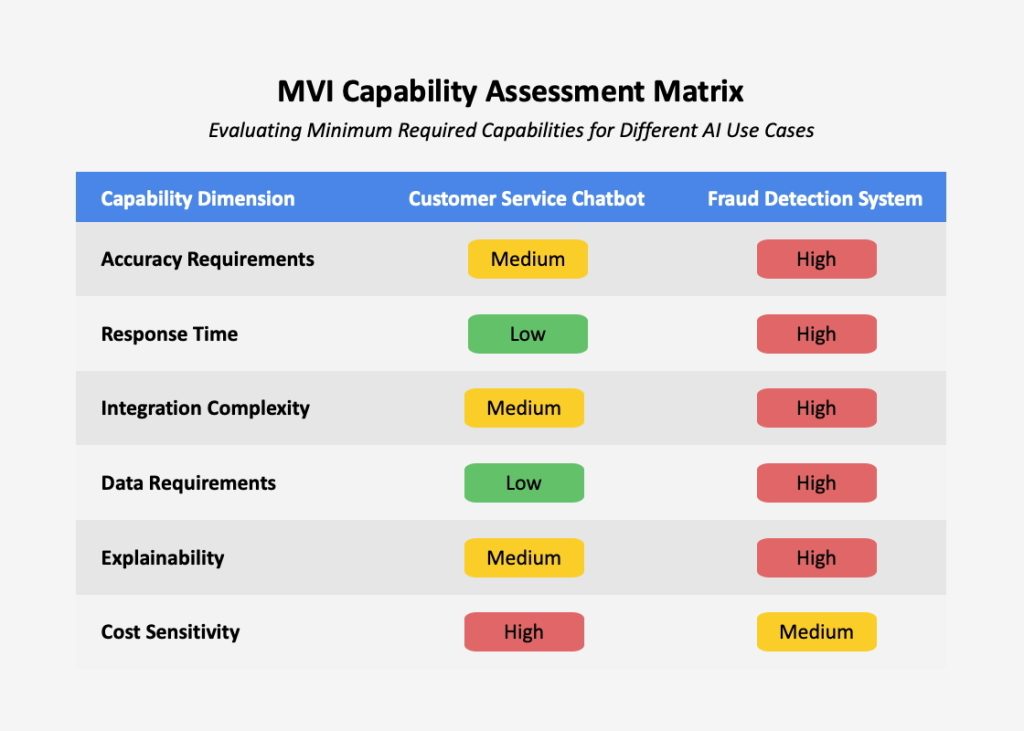
1. Accuracy Requirements
- Low: Some errors are acceptable and can be addressed through human review or failsafes
- Medium: Errors should be infrequent and primarily occur in edge cases
- High: Extremely high precision required with minimal error tolerance (e.g., fraud detection, medical applications)
2. Response Time
- Low: Batch processing is acceptable; responses in minutes to hours are sufficient
- Medium: Near real-time responses required (seconds to minutes)
- High: Immediate responses essential (milliseconds to seconds), such as for interactive applications
3. Integration Complexity
- Low: Standalone solution with minimal integration points
- Medium: Integration with 2-3 core business systems required that have existing APIs to connect to
- High: Deep integration across multiple enterprise systems and data sources
4. Data Requirements
- Low: Uses readily available structured data with minimal preparation needed
- Medium: Requires multiple data sources with moderate cleansing and preparation
- High: Demands extensive data from diverse sources, including unstructured data requiring significant preprocessing; also requires high data security
5. Explainability
- Low: Black-box solutions acceptable where outcomes alone are sufficient
- Medium: Some ability to understand key factors influencing decisions
- High: Full transparency required to explain how and why decisions are made (regulatory/compliance contexts)
6. Cost Sensitivity
- Low: High budget tolerance if ROI is clear
- Medium: Traditional cost-benefit analysis guides investment decisions
- High: Strict budget constraints requiring lean, efficient solutions
Starting Small: The Pilot Project Approach
One of the most effective ways to implement MVI is through carefully designed pilot projects:
- Select a high-value, contained use case
- Choose use cases from the “Quick Wins” quadrant when possible
- Ensure the scope is narrow enough to implement quickly
- Verify the problem represents broader organizational challenges
- Define clear success metrics
- Establish quantitative and qualitative measures of success
- Include both technical performance and business impact metrics
- Set realistic targets based on your problem definition
- Start with the simplest viable solution
- Begin with the least complex technology that could address the need
- Focus on core functionality before adding features
- Use existing tools and platforms when possible, to save on costs
- Build in feedback mechanisms
- Collect user feedback systematically
- Monitor performance against success metrics
- Document learnings and insights throughout the process
- Plan for iteration and scaling
- Design the pilot with potential expansion in mind
- Identify clear decision points for scaling or pivoting
- Document requirements for broader implementation
Measuring Success: KPIs for MVI Implementations
Effective measurement is essential for validating your MVI approach. The following are some example metrics you can use, just make sure the metrics fit your business goals and use case.
Business Impact Metrics
- Revenue increase or cost reduction
- Time savings or productivity improvements
- Customer satisfaction or Net Promoter Score changes
- Error reduction or quality improvements
- Employee satisfaction and adoption rates
Technical Performance Metrics
- Accuracy, precision, recall (for predictive models)
- Response time and system latency
- Uptime and reliability
- Escalation rate (how often the AI system needs human intervention)
- Resource utilization (computing, storage, API calls, etc.)
Implementation Efficiency Metrics
- Time to implementation
- Development and deployment costs
- Integration complexity and effort
- Maintenance requirements
- Scalability metrics
Scaling Considerations: When and How to Increase AI Capabilities
As your AI initiatives mature, you’ll need to make decisions about expanding capabilities. Use these guidelines:
- Evidence-based expansion: Only increase capabilities when there’s clear evidence that current capabilities are insufficient to meet business needs.
- Incremental approach: Add capabilities incrementally rather than making major leaps in complexity.
- Value-driven prioritization: Prioritize capability expansions based on potential business value, not technological appeal.
- Platform considerations: Select initial solutions with architectures that allow for capability expansion without complete rebuilds.
- Reusability focus: Design components and data pipelines to be reusable across multiple AI initiatives.
Future-Proofing Your MVI Strategy
Technology Trends Affecting MVI
The AI landscape continues to evolve rapidly, with several trends affecting how organizations should approach MVI:
- Democratization of AI: As advanced AI capabilities become more accessible and affordable, the “minimum viable” level may increase while costs decrease.
- Specialized industry solutions: Pre-built industry-specific AI solutions are reducing the need for custom development in many common use cases.
- Hybrid approaches: Combinations of rules-based systems and AI can be more efficient than pure AI approaches for certain problems.
- Multi-capable foundation models: Models that can handle multiple modalities (text, image, voice) from a single architecture are changing the economics of certain AI applications.
Building Flexibility into Your AI Infrastructure
To ensure your MVI strategy remains effective as technologies evolve:
- Adopt modular architectures: Design systems with interchangeable components that can be upgraded independently. Adaptability requires more upfront cost, so factor that into your cost-benefit analysis.
- Prioritize data strategy: Ensure you build good-quality, well-structured data assets that can fuel any AI technology.
- Develop internal expertise: Invest in building core AI literacy throughout the organization to improve decision-making.
- Establish governance processes: Create clear processes for evaluating, approving, and monitoring AI implementations.
Ethical Considerations for Sustainable AI Deployment
As you implement your MVI strategy, integrate these ethical considerations:
- Transparency: Ensure affected stakeholders understand when and how AI is being used.
- Fairness and bias: Evaluate AI systems for potential biases, particularly when making decisions affecting customers or employees.
- Privacy protection: Implement strong data privacy practices, particularly for systems using personal information.
- Human oversight: Maintain appropriate human supervision, especially for higher-risk applications.
Conclusion
Implementing the Minimum Viable Intelligence (MVI) approach is about turning smart strategies into tangible results. By following a structured assessment process, starting with targeted pilot projects, and measuring success through clear KPIs, you can ensure your AI initiatives are both impactful and sustainable. The MVI principles empower you to align AI capabilities with your specific business needs, helping you avoid costly pitfalls and achieve measurable outcomes.
Remember, successful AI implementation doesn’t require taking massive leaps; it’s about starting small, learning from each step, and scaling intelligently. By staying focused on value-driven expansion, your organization can future-proof its AI strategy and stay agile in an evolving technological landscape.
It’s the perfect moment to turn your insights into action. Take a look at your current challenges, align them with the MVI approach, and make that crucial first move toward smarter AI investments. A game-changing breakthrough might just be one well-executed project away. And if you have any questions or need a hand, the team at Hyacinth AI is here to support you every step of the way!